Labs · Forces
Elastic Collisions & Momentum
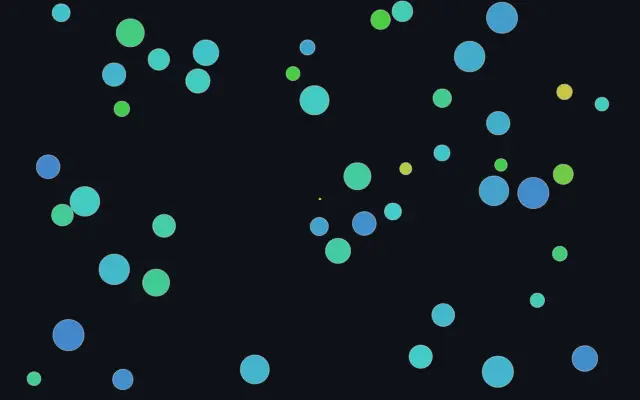
When two balls collide, the impulse acts along the line between their centres. Solving for it so that momentum Σ m·v is conserved (and kinetic energy too when e = 1) gives:
j = −(1 + e)(v_rel · n) / (1/m₁ + 1/m₂)
Mass is proportional to area, so a big ball shoves small ones easily while barely changing its own velocity. Lower the restitution to make collisions lose energy (inelastic), like clay.
Load "Newton's cradle row", then grab and throw a ball. Watch the momentum readout stay constant between wall hits.
Controls
- Scene
- Balls (gas / small)
- Restitution e
- Gravity
- Colour by
- Show total momentum arrow
Evolved from Forces: Gravity, Wind, Friction & Drag.
Evolved into Ideal Gas & Maxwell–Boltzmann.