Labs · Randomness
Distributions
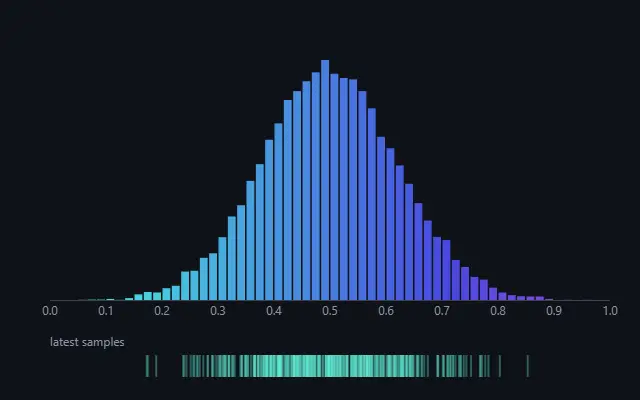
Gather thousands of random numbers into a histogram and the shape of their distribution appears.
- Uniform comes out flat.
- Gaussian makes the bell curve, the shape of heights, measurement errors and much of nature.
- Accept–reject (Monte Carlo) builds any custom distribution. It picks a value, then keeps it only with a probability you choose (here
x²). - Sum of two uniforms gives a triangle. Add more and you approach a bell curve (the central limit theorem).
- Perlin noise values crowd around 0.5, because noise is smooth, not uniform.
Controls
- Generator
- Bins
- Samples per frame
- Std. deviation (Gaussian)
Evolved into Monte Carlo π, Paint Your Own Distribution.