Labs · Oscillation
Double Pendulum & Chaos
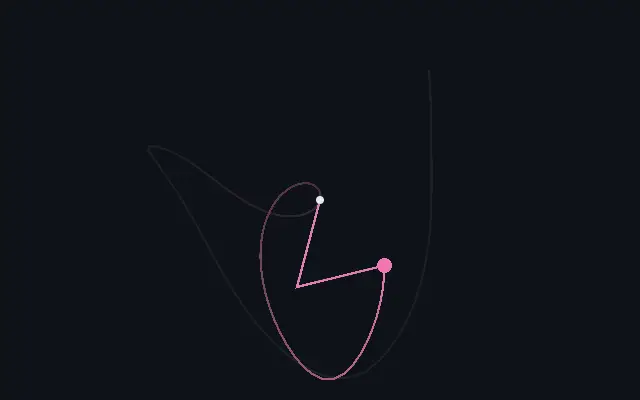
Hang a pendulum from a pendulum and the motion becomes chaotic: fully deterministic, yet impossible to predict over the long run.
This experiment starts many double pendulums whose first angles differ by a tiny amount (10⁻⁶ radians by default). They move as one at first, then the differences grow exponentially and they fan out. This is the butterfly effect. The equations of motion come from Lagrangian mechanics and are integrated with 4th-order Runge–Kutta.
Set the perturbation to −9 (10⁻⁹) and count how much longer they stay together.
Controls
- Pendulums
- Start angle 1 (°)
- Start angle 2 (°)
- Perturbation (log₁₀ rad)
- Mass ratio m₂ / m₁
- Length ratio L₂ / L₁
- Gravity
- Time speed
- Trace
- Draw rods
- First colour
- Last colour
Evolved from Pendulum Wave.
Evolved into Phase Space & Strange Attractors.