Labs · Oscillation
Fourier Series: Building Waves
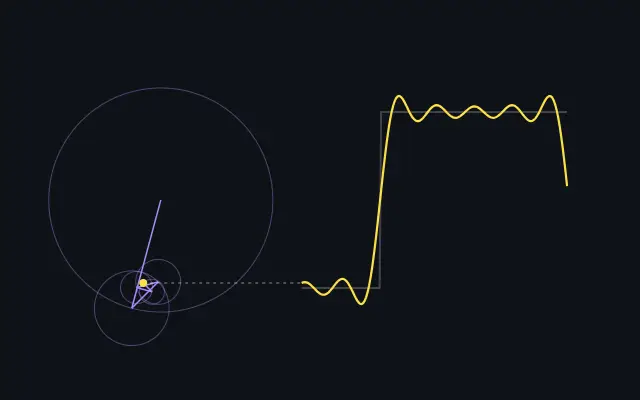
The 1D version of epicycles. A square wave is the sum of odd harmonics (4/π)·[sin t + sin 3t/3 + sin 5t/5 + …]. Each harmonic is a rotating arrow (phasor), and chaining them traces the wave on the right.
Adding terms sharpens the corners, but the overshoot next to each jump never disappears. It stays about 9% high no matter how many terms you add. This is the Gibbs phenomenon.
Compare the triangle wave (its harmonics shrink like 1/n², so it converges fast) with the square wave (1/n).
Controls
- Waveform
- Harmonics
- Speed
- Show ideal waveform
- Wave colour
- Phasor colour
Evolved from Fourier Epicycles.