Labs · Randomness
Procedural Noise Planet
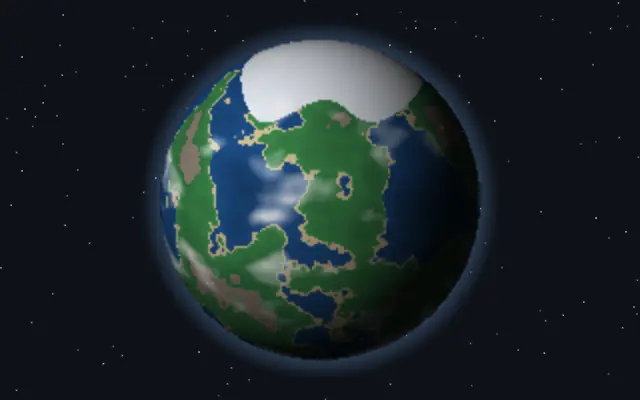
Wrap noise around a sphere and you get a world. For each pixel of the disc we work out the 3D point on the sphere's surface, rotate it, and sample 3D Perlin noise there. Sampling in 3D avoids the seams and pinched poles you get when wrapping a flat 2D map.
Height decides ocean, beach, forest, rock or snow. Latitude adds polar ice. A dot product between the surface normal and the light direction gives day and night shading, the same vector math as in Chapter 1.
Press "New world" a few times, then lower the sea level to raise the continents.
Controls
- Continent scale
- Detail (octaves)
- Sea level
- Rotation speed
- Clouds
- Pixel size
- Ocean colour
- Land colour
- Mountain colour
Evolved from Flying Over Noise Terrain.