Labs · Cellular Automata
Reaction–Diffusion (Gray–Scott)
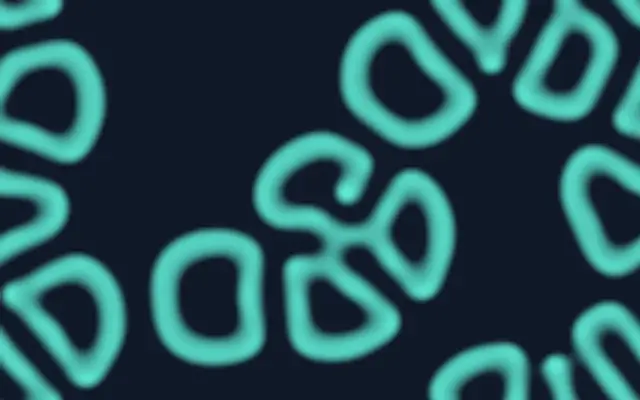
A cellular automaton with continuous states. Every cell holds amounts of two chemicals, A and B. Each step they diffuse to neighbouring cells (a 3×3 Laplacian), B consumes A to make more B (A + 2B → 3B), A is fed in at rate f, and B is killed at rate k.
Tiny changes to f and k give wildly different "species" of pattern: coral, dividing cells, mazes, worms. Alan Turing proposed in 1952 that this kind of process could explain animal markings.
Choose "Mitosis", then paint with the mouse and watch the spots split like cells.
Controls
- Pattern preset
- Feed rate f
- Kill rate k
- Cell size (px)
- Steps per frame
- Brush size
- Colour of A
- Colour of B
Evolved from Elementary Cellular Automata.
Evolved into Forest Fire Model.