Labs · Oscillation
Oscillation & Waves
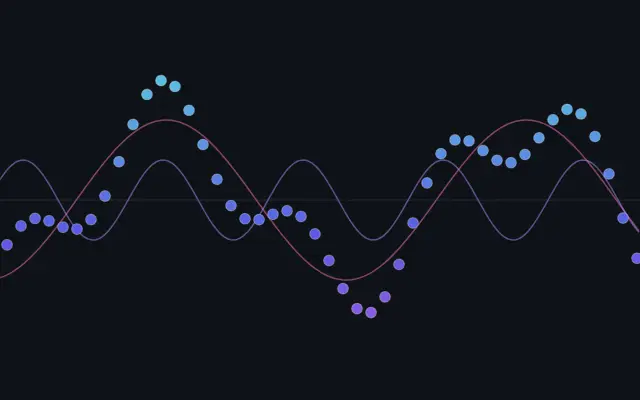
Simple harmonic motion follows a sine: y = A·sin(2π·x / λ + φ). Amplitude A sets the height, wavelength λ sets the spacing, and advancing the phase φ each frame makes the wave travel.
Adding two waves (superposition) produces interference: beats, standing waves and complex shapes. Each bead only moves up and down, yet together they look like a moving wave.
Give both waves the same wavelength and opposite speeds to make a standing wave.
Controls
- Wave 1 amplitude
- Wave 1 wavelength
- Wave 1 speed
- Wave 2 amplitude
- Wave 2 wavelength
- Wave 2 speed
- Bead spacing
- Show component waves
Evolved into Fourier Epicycles, Ripple Tank (2D Wave Equation).