Verlet integration moves points using only where they are and where they were, which makes constraints easy: connect points with sticks of fixed length and you get cloth, rope and ragdolls. Pull the cloth and cut it, throw the ragdolls around. Make the points solid circles and they stack, pour through a Galton board into a bell curve, and drain through an hourglass at a steady rate — the strange way sand flows.
Every simulation below runs right here in your browser, for free, with live controls. Open one, change the sliders, and use the mouse — most of them respond to it.
Physics simulations
Verlet Physics: Cloth & Ropes
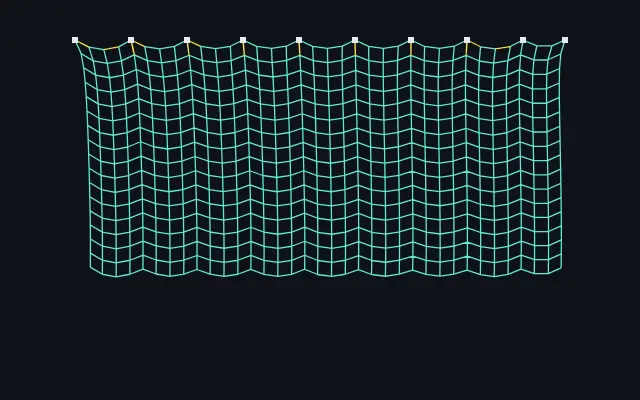
Physics libraries usually split the work into bodies and constraints. This is a small engine written from scratch using Verlet integration: each point remembers only its current and previous position, so velocity is implied by the difference.
Stick constraints then push connected points back to their rest distance, repeated several times per frame (iterations). More iterations make the material stiffer. Overstretched sticks can tear.
Try this: Drag the cloth with the left mouse button. Cut it with the right mouse button (or Shift + drag). Then try "Unpin all".
Open Verlet Physics: Cloth & Ropes →
Rigid Circles & the Galton Board
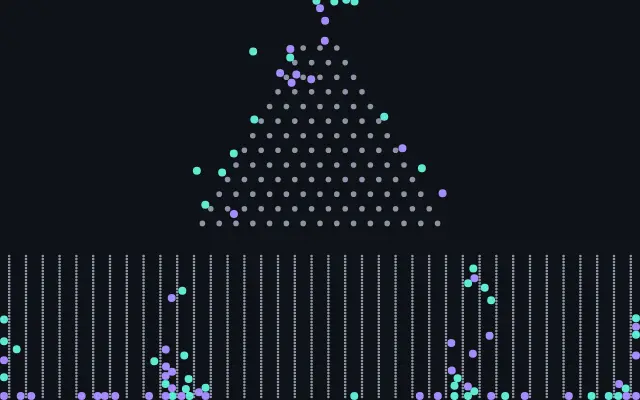
The cloth demo used distance constraints between connected points. Collisions work the same way, with "stay at least r₁ + r₂ apart" as a constraint between every pair of touching circles. A spatial grid finds those pairs quickly, and repeating the solver several times per frame lets tall piles settle stably.
The Galton board scene closes a loop with Chapter 0. Each ball bounces left or right at random on every peg, and the bins fill into a binomial / normal distribution, a physical histogram.
Try this: In "Pile", click to drop balls and drag one to stir the heap. Raise the solver iterations if piles look squishy.
Open Rigid Circles & the Galton Board →
Verlet Ragdolls
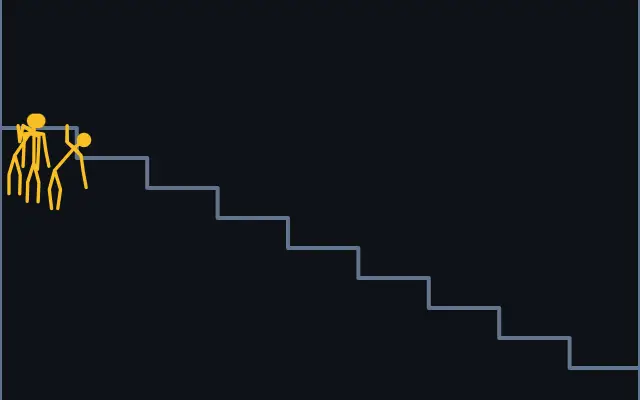
The cloth was a grid of points and sticks. Rearrange those same parts into a skeleton and you get a ragdoll: 13 points (head, shoulders, elbows, hands, pelvis, knees, feet) joined by sticks as bones. Extra cross-sticks keep the torso rigid, so the body flops naturally at the joints only.
Points collide with the stairs as small circles and get friction from the surface. This is exactly how many games animated falling characters in the 2000s.
Try this: Drag a ragdoll by its head up to the top of the stairs and let go. Then press "Drop more".
Granular Hourglass
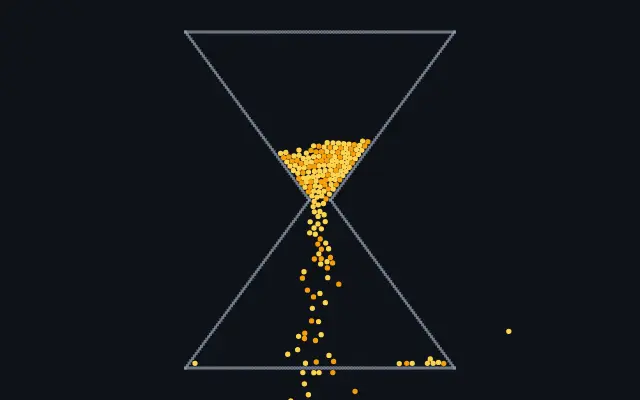
Sand flows strangely. Unlike water, an hourglass drains at a constant rate regardless of how much sand is above the neck (the Beverloo law). The weight of the pile is carried sideways by force chains into the walls, so the grains at the neck don't feel the full load. That is why hourglasses keep time.
This uses the same position-based circle solver as the stacking demo. Watch the flow-rate readout stay steady while the top chamber empties.
Try this: Make the neck narrower until the grains jam (an arch forms), then widen it slightly.
Evolve them into something new
Several of these are already evolutions: Rigid Circles & the Galton Board grew out of Verlet Physics: Cloth & Ropes; Verlet Ragdolls grew out of Verlet Physics: Cloth & Ropes; Granular Hourglass grew out of Rigid Circles & the Galton Board. In Labs you can take any of them a generation further: press Evolve this, get suggestions for what the next version could add, and build the one you like — or combine two or three simulations into one system.
Make your own simulation →
Pick physics as a concept, choose an art piece, game, explainer or experiment, and Labs suggests ideas and builds the one you choose.