Stephen Wolfram’s elementary automata use a single row and a rule number from 0 to 255; Rule 30 produces patterns so random they were used to generate random numbers. Conway’s Game of Life uses a 2D grid and two rules for birth and survival, yet it can build machines. Change the rules and you get forest fires, avalanching sandpiles, cyclic spirals and Langton’s ant building its highway.
Reaction–diffusion swaps the on/off cells for chemical concentrations and grows the spots and stripes found on animal coats.
Every simulation below runs right here in your browser, for free, with live controls. Open one, change the sliders, and use the mouse — most of them respond to it.
Cellular Automata simulations
Elementary Cellular Automata
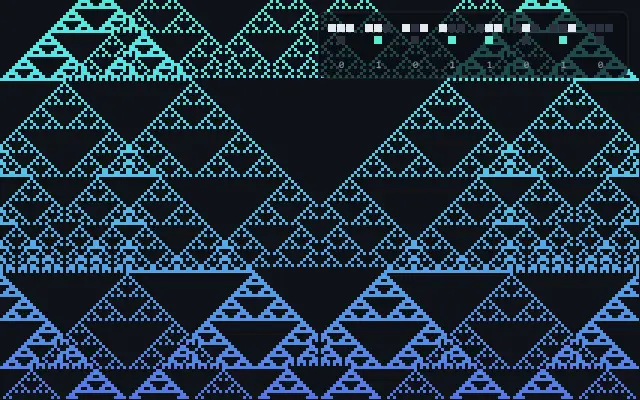
Stephen Wolfram's elementary CA is a single row of cells, each on or off. A cell's next state depends only on itself and its two neighbours, so there are 8 possible neighbourhoods. A rule is the 8-bit number that lists the output for each one, which gives 256 rules.
Each generation is drawn under the previous one, so time runs downward. Wolfram sorted the rules into four classes: uniform, repeating, random-looking (rule 30), and complex (rule 110, which is Turing-complete).
Open Elementary Cellular Automata →
Game of Life & Friends
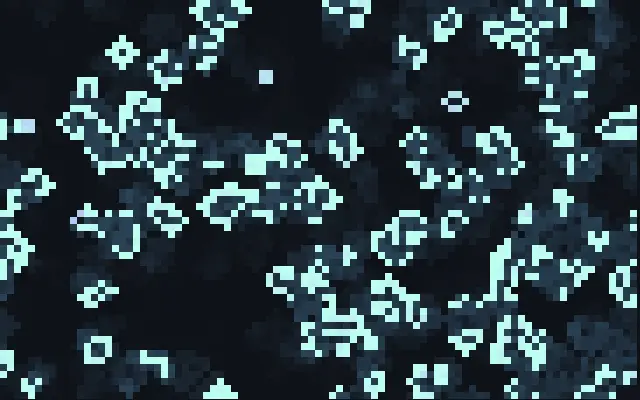
John Conway's Game of Life is a 2D cellular automaton. Each cell counts its 8 neighbours. A dead cell with exactly 3 live neighbours is born (B3), and a live cell with 2 or 3 survives (S23). Every other cell dies or stays dead.
From these rules come still lifes, oscillators, gliders that travel across the grid, and even guns that fire gliders. Other rulesets (written B…/S…) produce very different worlds.
Try this: Paint cells with the left mouse button and erase with the right. Load the Gosper glider gun and watch it fire.
Reaction–Diffusion (Gray–Scott)
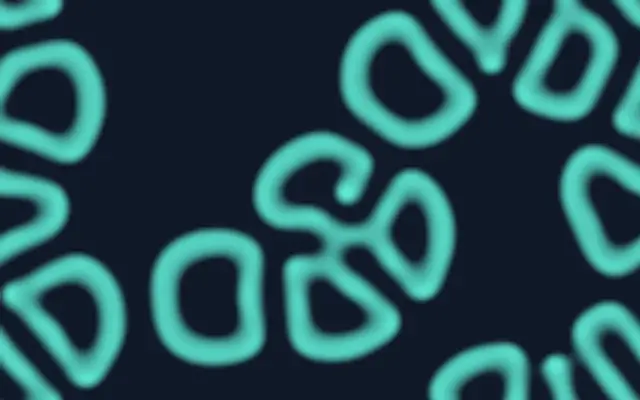
A cellular automaton with continuous states. Every cell holds amounts of two chemicals, A and B. Each step they diffuse to neighbouring cells (a 3×3 Laplacian), B consumes A to make more B (A + 2B → 3B), A is fed in at rate f, and B is killed at rate k.
Tiny changes to f and k give wildly different "species" of pattern: coral, dividing cells, mazes, worms. Alan Turing proposed in 1952 that this kind of process could explain animal markings.
Try this: Choose "Mitosis", then paint with the mouse and watch the spots split like cells.
Open Reaction–Diffusion (Gray–Scott) →
Langton's Ant & Turmites
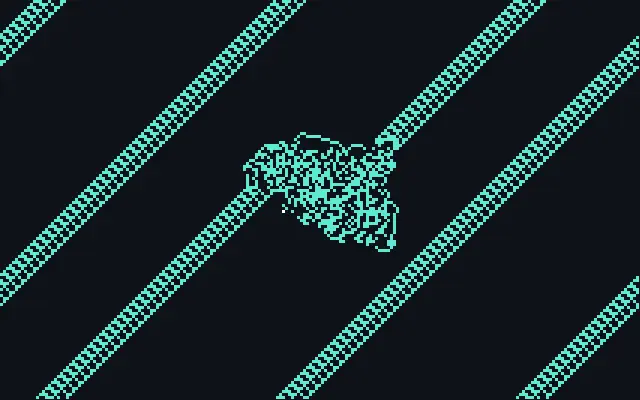
Instead of every cell updating at once, a single ant walks the grid. It reads the colour under it, turns according to a rule string (R right, L left, N none, U U-turn), advances that cell to the next colour, and steps forward.
The classic rule RL makes chaos for about 10,000 steps, then suddenly builds a repeating diagonal "highway" forever. Longer rule strings (turmites) grow symmetric shapes, triangles and spirals.
Try this: Type your own rule like RRLLR and press Enter, or add more ants and watch them interfere.
Open Langton's Ant & Turmites →
Atlas of All 256 Rules
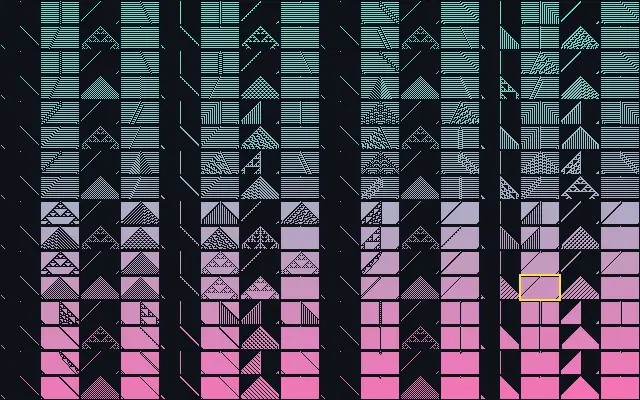
Every elementary CA rule at once. Each thumbnail is one rule from 0 to 255, run from the same start. Seen side by side, Wolfram's four classes jump out: rules that die (class 1), rules that settle into stripes or repeating patterns (2), chaotic rules like 30 (3), and the rare complex ones like 110 (4).
Many rules are mirror images or colour-inverses of others, so there are only 88 truly different behaviours.
Try this: Click any thumbnail to enlarge it (click again to close). Switch to a random start to reveal more structure.
Cyclic Cellular Automaton
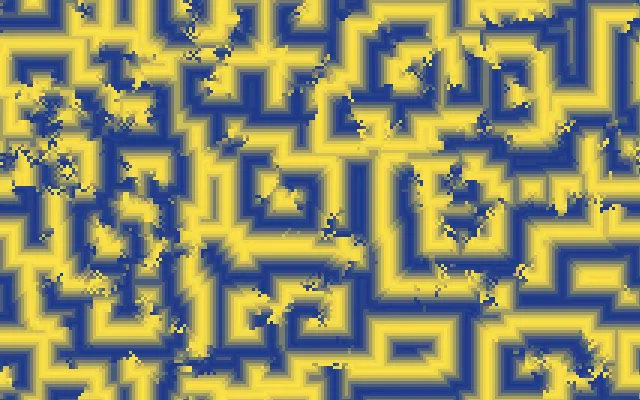
Each cell holds one of N states arranged in a cycle, like rock-paper-scissors with many hands. A cell advances to the next state if at least threshold of its neighbours are already in that next state, because the next state "eats" the current one.
From random noise, small cycles that happen to form become self-sustaining, and they grow into huge rotating spirals that take over the grid. Similar spirals appear in real chemical reactions (Belousov–Zhabotinsky) and in heart tissue.
Try this: Try the presets. "Spiral demons" makes the classic look; "Turbulent" shows a different class of behaviour.
Open Cyclic Cellular Automaton →
Forest Fire Model
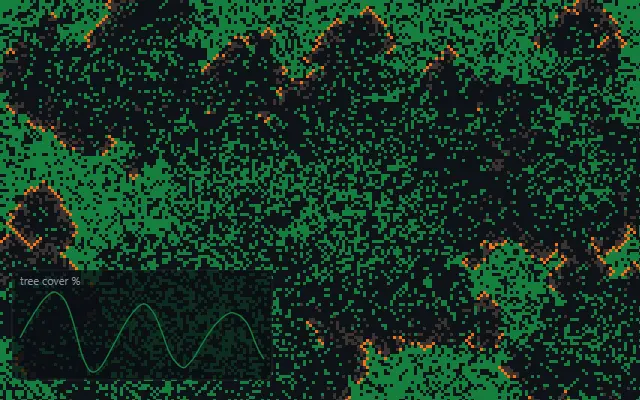
A probabilistic cellular automaton (Drossel & Schwabl, 1992). Each step, empty ground sprouts a tree with probability p, lightning ignites a tree with a tiny probability f, fire spreads to neighbouring trees, and burnt cells become empty.
Forests grow until they are dense enough for a single strike to burn huge areas. The system tunes itself to the edge, producing fires of all sizes (a power law). This is called self-organised criticality.
Try this: Click to start a fire yourself. Raise the growth rate and watch the fronts become spiral waves.
Abelian Sandpile
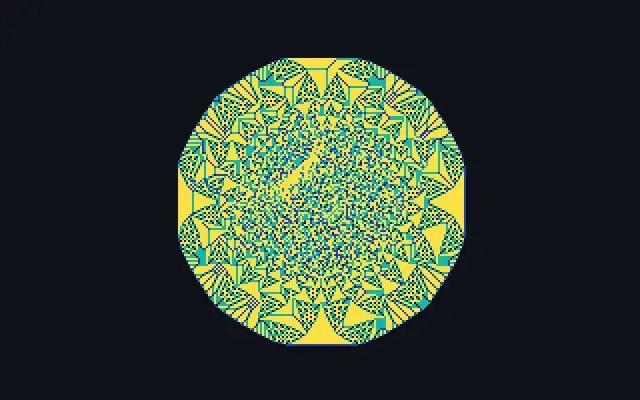
Drop grains of sand one at a time onto a grid. A cell holding 4 or more grains topples, passing one grain to each of its four neighbours, which may topple in turn: an avalanche. That single rule (Bak, Tang & Wiesenfeld, 1987) was the first model of self-organised criticality.
Pour everything onto the centre and a stunning fractal appears, with the same result whatever order the topplings happen in (that is the "Abelian" part). With random drops, avalanche sizes follow a power law: mostly tiny, occasionally enormous.
Try this: Let the centre pile grow for a while and look at the self-similar triangles inside it. Click to drop sand anywhere.
Evolve them into something new
Several of these are already evolutions: Reaction–Diffusion (Gray–Scott) grew out of Elementary Cellular Automata; Langton's Ant & Turmites grew out of Game of Life & Friends; Atlas of All 256 Rules grew out of Elementary Cellular Automata; Cyclic Cellular Automaton grew out of Game of Life & Friends. In Labs you can take any of them a generation further: press Evolve this, get suggestions for what the next version could add, and build the one you like — or combine two or three simulations into one system.
Make your own simulation →
Pick cellular automata as a concept, choose an art piece, game, explainer or experiment, and Labs suggests ideas and builds the one you choose.