Each agent carries a small neural network as its brain: sensors go in, steering comes out. A population starts with random brains and mostly crashes. The ones that survive longest are copied with mutations, and within a few generations the population drives laps, balances a pole on a cart, or lands a rocket softly — behaviours that emerge without a single line of driving code.
Every simulation below runs right here in your browser, for free, with live controls. Open one, change the sliders, and use the mouse — most of them respond to it.
Neuroevolution simulations
Neuroevolution Ecosystem
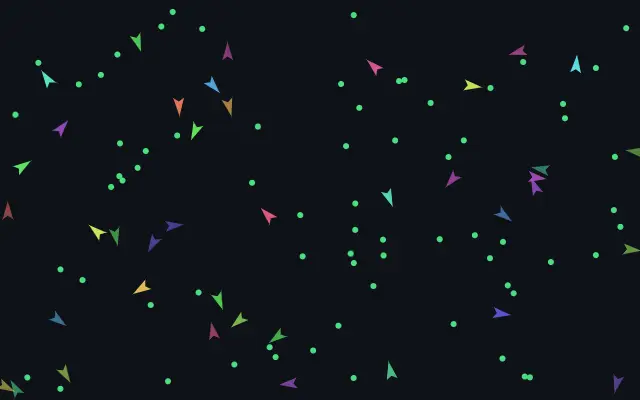
Neuroevolution combines the last two chapters. Each creature is steered by its own small neural network, but there is no backpropagation and no "correct answer". The weights evolve instead.
Inputs: the direction and distance to the nearest food it can sense, its energy and its speed. Outputs: turn and thrust. Moving costs energy and eating restores it. When a creature starves it is replaced by a mutated copy of a successful survivor, chosen with probability ∝ food eaten.
Try this: Set the speed to 10 for a minute, then back to 1 to watch the evolved behaviour.
Open Neuroevolution Ecosystem →
Neuroevolution: Self-Driving Cars
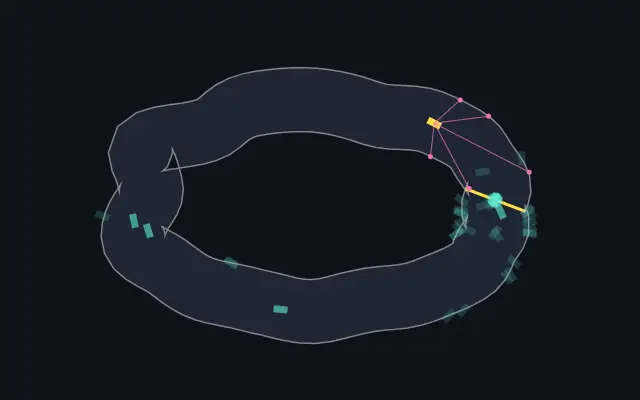
Each car sees the world through five distance sensors (ray casts against the track walls) plus its own speed. Those 6 numbers feed a small neural network whose two outputs are steering and throttle.
Unlike the ecosystem demo, this is generational. All cars drive at once, a car dies when it hits a wall or stops making progress, and fitness is how far along the track it got. The best drivers survive unchanged (elitism) and mutated copies of good drivers fill the next generation.
Try this: Once cars complete laps, press "New track" to see if the evolved brains generalise to a road they have never seen.
Open Neuroevolution: Self-Driving Cars →
Neuroevolution: Balancing a Pole
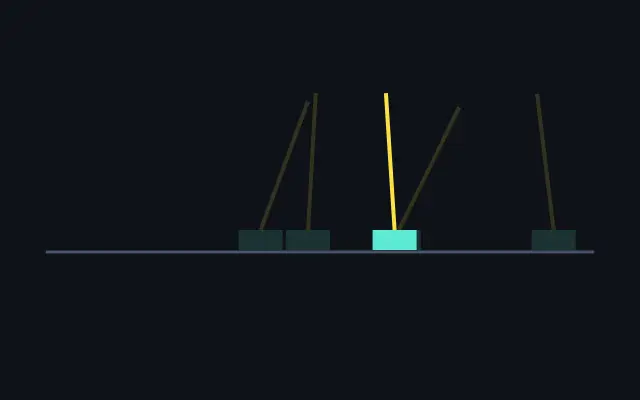
The classic control benchmark. A pole is hinged on a cart, and the only way to keep it upright is to push the cart left or right, like balancing a broom on your hand. Each cart's neural network sees four numbers (cart position and velocity, pole angle and angular velocity) and outputs a push force.
The whole population is drawn on the same track, ghosted. Carts drop out when the pole falls past 40° or the cart leaves the track. Fitness is survival time. Within a few generations, evolution typically finds a controller that balances indefinitely.
Try this: Once they balance, enable "Random gusts" to test how robust the evolved controllers are.
Open Neuroevolution: Balancing a Pole →
Neuroevolution: Rocket Landing
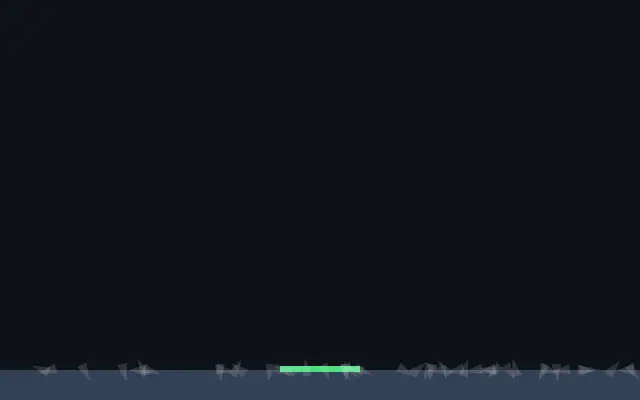
A harder control problem. Each rocket starts high up with a random drift and must touch down gently, upright and on the pad. Its network sees seven numbers (offset to the pad, altitude, both velocity components, the tilt as sine and cosine, and its spin) and controls the main engine and two steering thrusters.
Fitness rewards ending near the pad, with big bonuses for a soft, upright landing. Early generations plummet or fly off. Watch them discover hovering, then braking, then precise landings.
Try this: Raise the simulation speed to 10 for a minute, then drop it back to 1 and watch the evolved landers.
Open Neuroevolution: Rocket Landing →
Evolve them into something new
Several of these are already evolutions: Neuroevolution: Self-Driving Cars grew out of Neuroevolution Ecosystem; Neuroevolution: Balancing a Pole grew out of Neuroevolution Ecosystem; Neuroevolution: Rocket Landing grew out of Neuroevolution: Self-Driving Cars. In Labs you can take any of them a generation further: press Evolve this, get suggestions for what the next version could add, and build the one you like — or combine two or three simulations into one system.
Make your own simulation →
Pick neuroevolution as a concept, choose an art piece, game, explainer or experiment, and Labs suggests ideas and builds the one you choose.