Step 1: an evaluation for every position
Stockfish evaluates the position before and after each move in centipawns: +100 means White is roughly a pawn better. A forced mate is treated as a very large number.
Step 2: centipawns become winning chances
A pawn matters much more in a level position than when you are already a rook up, so evaluations are converted into winning chances from 0 to 100%. Doathingy uses the curve Lichess publishes, fitted to millions of real games:
winning chances = 50 + 50 × (2 / (1 + e−0.00368208 × centipawns) − 1)
Level is 50%. +1.0 (a pawn up) is about 59%; +3.0 is about 75%; +10 is over 97%. That is why giving away a pawn in a balanced position costs far more than in a won one.
Step 3: how much did each move cost?
For each move, the drop in the mover’s winning chances is measured: if you were at 60% before your move and 48% after it, the move cost 12 points. The engine’s own move, or anything within half a point of it, costs nothing.
Step 4: per-move accuracy
Each drop becomes an accuracy between 0 and 100:
move accuracy = 103.1668 × e−0.04354 × drop − 3.1669
A perfect move scores 100. A 5-point drop scores about 80; 10 points about 64; a 25-point blunder about 31. The curve is steep at first, so small slips are punished almost as much as you would expect — and a single blunder can’t take you below zero.
Step 5: game accuracy
Your game accuracy is the average of your move accuracies, and the same is done separately for the opening, middlegame and endgame. That split is often more telling than the total: many club players are at 85% in the opening and 60% in the middlegame.
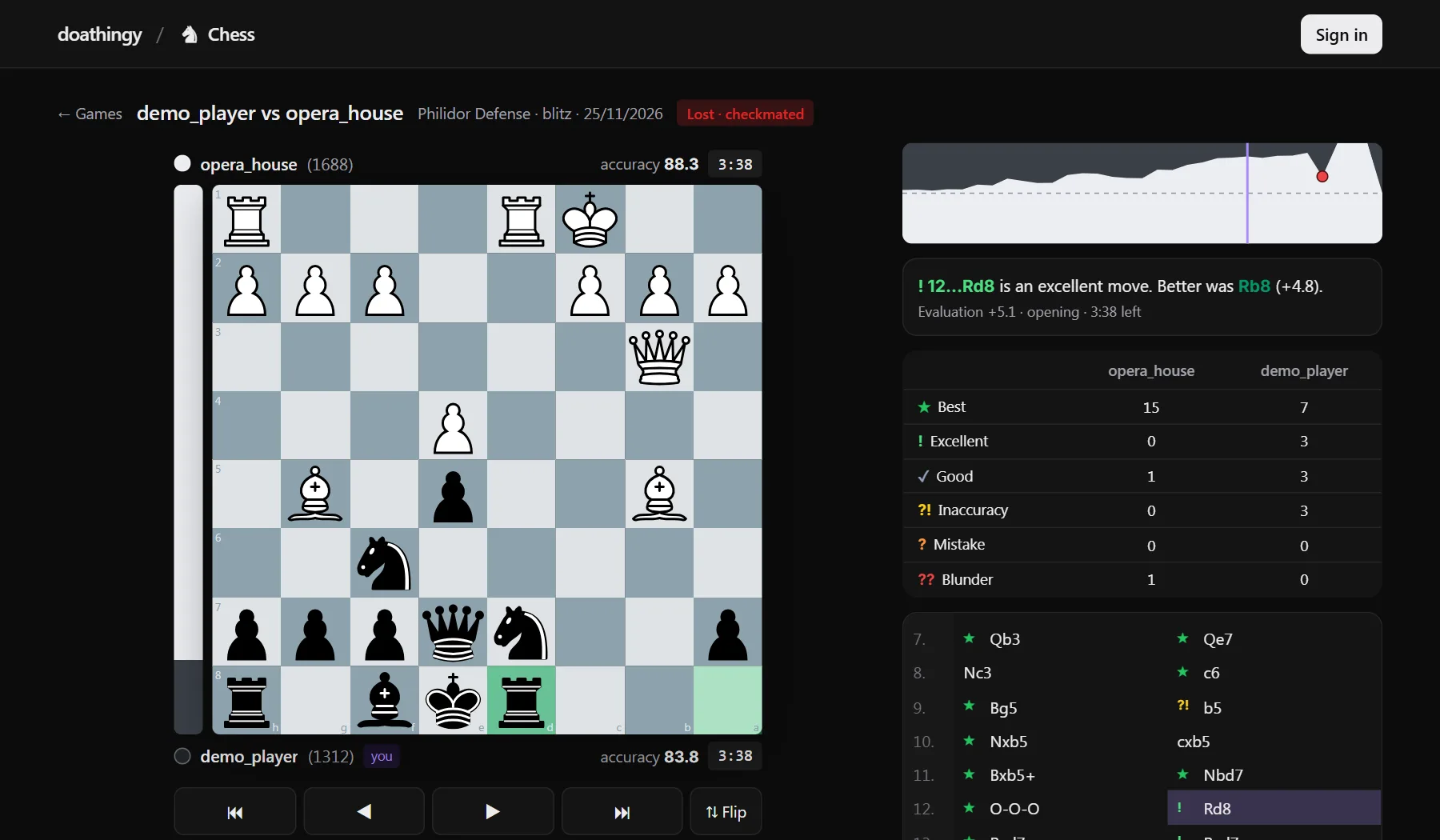
Why accuracy differs between sites
- Different formulas. Chess.com’s accuracy (CAPS) uses its own unpublished method; Lichess and Doathingy use the published winning-chance formulas above.
- Different depth. A deeper search finds better moves, which can turn a “best” move into an inaccuracy and back.
- Short and one-sided games score high: a 20-move game where your opponent collapsed gives you few chances to go wrong.
What is a good accuracy?
It depends on the game more than the player. Quiet, simple games produce high numbers at every level; sharp tactical games produce low ones even for strong players. Compare your accuracy across many games — the stats dashboard shows its spread, and your accuracy in wins versus losses — rather than reading too much into one.
Accuracy also doesn’t say why moves cost points. For that, look at the moves themselves: how moves are classified explains the labels.
See your accuracy, move by move
Free Stockfish review of your Chess.com games.
Questions
How is chess accuracy calculated?
Each move’s drop in winning chances (from the engine’s evaluation) becomes a 0–100 accuracy with an exponential formula; game accuracy is the average over your moves.
Why is my accuracy different on Chess.com and Lichess?
Chess.com uses its own unpublished method (CAPS) while Lichess publishes its formulas; engine depth and settings also differ.
What is a good accuracy in chess?
There is no fixed number: simple games score high and sharp ones low at every level. Compare averages across many games instead of single results.
More chess guides
- Free Chess.com Game Review with Stockfish — Every Game, No Membership
- Blunder, Mistake or Inaccuracy? How Chess Moves Are Classified
- How to Analyse Your Chess Games (and Actually Improve)
- Why Do I Keep Losing at Chess? What Your Games Usually Show
- Chess.com Stats Dashboard: Win Rate by Colour, Opening, Time of Day and More
- AI Chess Coach: A Coaching Report from 20, 50 or 100 of Your Games
- Chess Puzzles from Your Own Games: Practise the Moves You Missed
- Doathingy Chess — free game review, stats and AI coaching