The thresholds
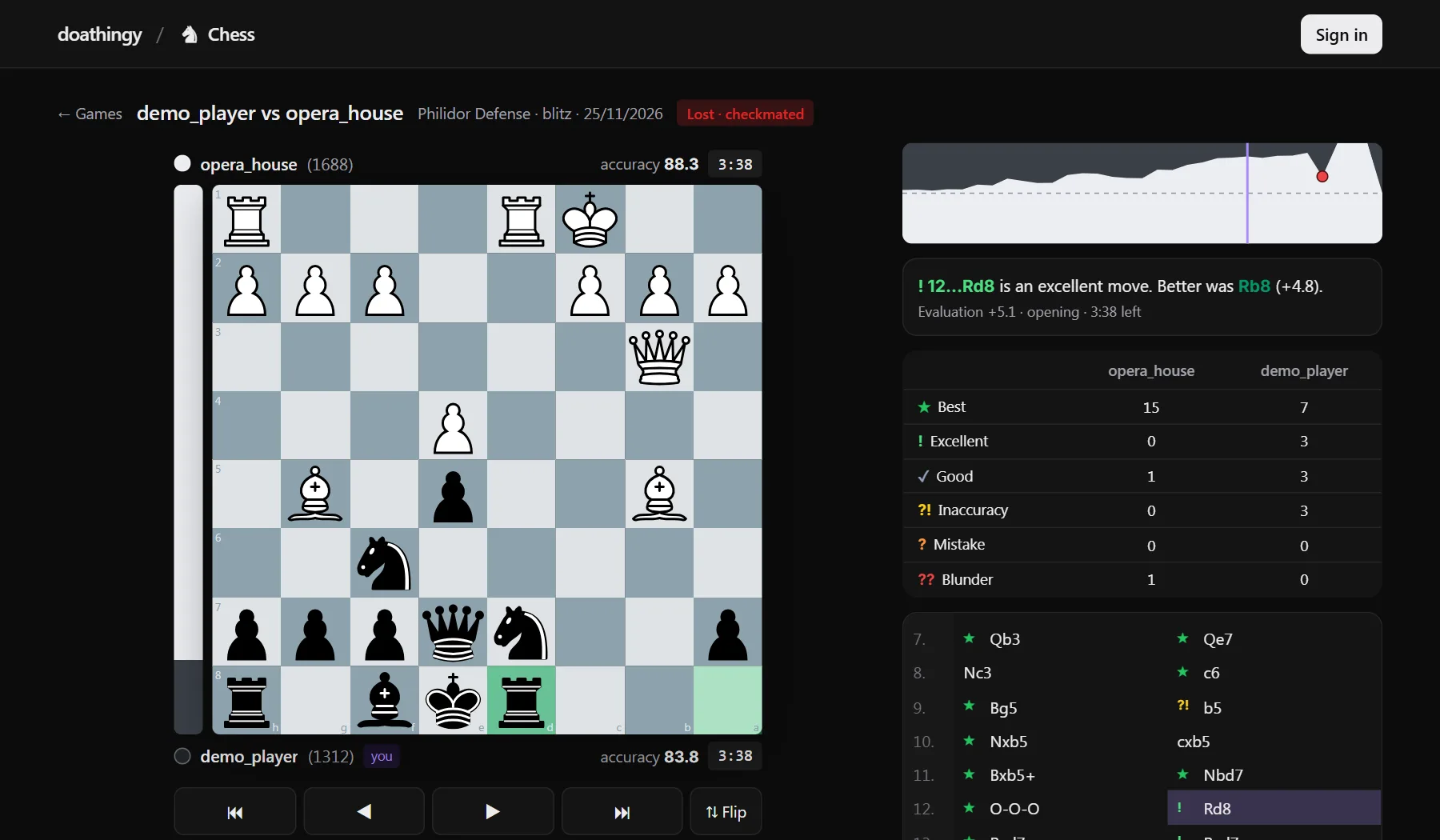
For each move, Doathingy measures how much it lowered the mover’s winning chances (see how accuracy is calculated). The drop decides the label:
| Label | Drop in winning chances | Roughly… |
|---|---|---|
| ★ Best | the engine’s move, or under 0.5 | nothing lost |
| ! Excellent | 0.5 – 2.5 | a near-perfect alternative |
| ✓ Good | 2.5 – 6 | a reasonable move, slightly worse |
| ?! Inaccuracy | 6 – 12 | gives away part of an edge |
| ? Mistake | 12 – 22 | changes the likely result |
| ?? Blunder | 22 or more | usually loses the game, or throws away a win |
Why winning chances, not pawns?
Losing a pawn is a big deal at 0.0 and almost nothing at +8. Measuring in winning chances makes the labels mean the same thing in every position: hanging a knight when you are already winning by a queen isn’t called a blunder, because it doesn’t change the result. Turning +0.5 into −1.5 is, because it turns a good game into a bad one.
Worked examples
- From +0.3 to −0.8: about 53% → 43%, a 10-point drop — an inaccuracy.
- From +1.0 to −1.0: about 59% → 41%, an 18-point drop — a mistake.
- From +2.0 to −2.0: about 68% → 32%, a 35-point drop — a blunder.
- From +9 to +5: about 96% → 86%, ten points — only an inaccuracy, even though four pawns were lost.
What to do with the labels
- Blunders are almost always tactical: a piece left loose, a check or capture not seen. Train with puzzles, and adopt a quick “what does their move attack?” check.
- Mistakes are often plans: the wrong pawn break, a trade that helps the opponent. Replay the engine’s line and ask what it wanted.
- Inaccuracies are the long tail. Don’t chase them until blunders are rare.
The fastest way to turn labels into improvement is to replay the positions where you went wrong. Practising your own mistakes shows how.
See every move labelled
Free Stockfish review of your Chess.com games.
Questions
What is the difference between a mistake and a blunder?
Both lose winning chances; a mistake costs 12–22 percentage points, a blunder 22 or more — usually enough to change the result.
What is an inaccuracy in chess?
A move that costs 6–12 percentage points of winning chances: a small concession, not a game-changing error.
More chess guides
- Free Chess.com Game Review with Stockfish — Every Game, No Membership
- What Does Chess Accuracy Mean? How Accuracy Scores Are Calculated
- How to Analyse Your Chess Games (and Actually Improve)
- Why Do I Keep Losing at Chess? What Your Games Usually Show
- Chess.com Stats Dashboard: Win Rate by Colour, Opening, Time of Day and More
- AI Chess Coach: A Coaching Report from 20, 50 or 100 of Your Games
- Chess Puzzles from Your Own Games: Practise the Moves You Missed
- Doathingy Chess — free game review, stats and AI coaching