1. Review losses first — and soon
Losses carry the clearest lessons, and you remember what you were thinking for an hour or two afterwards. That memory is the most valuable part of the review: an engine can say a move was bad, but only you know why you played it.
2. Think before the engine
Play through the game once without evaluations. Mark the moment you think it went wrong and what you were worried about. Then switch the engine on. The gap between your guess and the engine’s answer is what you are actually learning.
3. Find the turning point
Most games have one or two moves where the evaluation jumps. In Doathingy’s review the graph shows them as sharp drops, and Your key moments lists them under the board. Start there, not at move one.
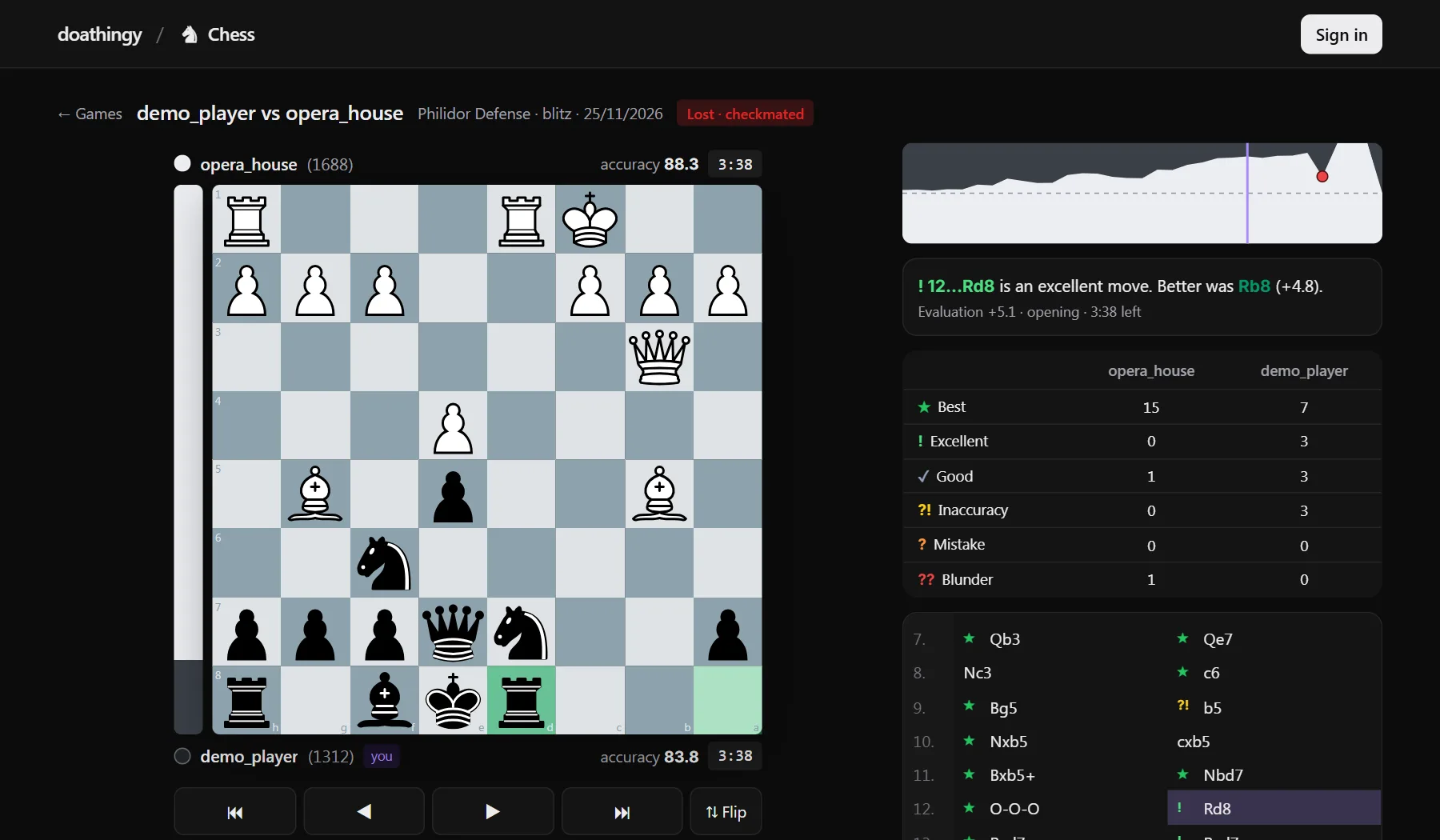
4. Ask three questions at the turning point
- What did my opponent’s last move threaten? Most blunders ignore a threat.
- What was the engine’s move trying to do? Play its line forward a few moves until the idea is clear.
- What would I need to notice next time? Write it as a habit: “check every capture my opponent has”.
5. Look for patterns across games
One game shows a mistake; twenty games show a habit. Once you have reviewed a few, look at them together:
- The stats dashboard shows where you lose: by colour, opening, time control, game length, time of day — and how (checkmate, resignation, time out).
- An AI coaching report does the pattern-finding for you: it reads 20, 50 or 100 games and names your strengths and the areas to develop in each phase.
6. Practise the positions
Reading the engine’s move once won’t make you find it next time. Replaying the position until you find it will. Puzzles from your own games turns your mistakes into exactly that.
Start with your last loss
Free review of every Chess.com game, in your browser.
More chess guides
- Free Chess.com Game Review with Stockfish — Every Game, No Membership
- What Does Chess Accuracy Mean? How Accuracy Scores Are Calculated
- Blunder, Mistake or Inaccuracy? How Chess Moves Are Classified
- Why Do I Keep Losing at Chess? What Your Games Usually Show
- Chess.com Stats Dashboard: Win Rate by Colour, Opening, Time of Day and More
- AI Chess Coach: A Coaching Report from 20, 50 or 100 of Your Games
- Chess Puzzles from Your Own Games: Practise the Moves You Missed
- Doathingy Chess — free game review, stats and AI coaching